Early sandblast lettering and its claims
The historical sources describe abrasive blasting as a means of removing exposed stone around a resist. Cook considers its effect on letter form; suppliers emphasize productivity and equipment. Those accounts should not be treated as interchangeable evidence. (LM pp.98, 134–135, 166–167; GMB16 p.497.)
Cook’s design argument
Section titled “Cook’s design argument”Cook believed the process could accommodate more delicate proportions than some hand- or pneumatic-cut work. He described a comparatively shallow letter section and a surface contrast different from a sharply cut V. These are observations and judgments in his manual, not a performance guarantee for current equipment. (LM pp.98, 134–135.)
Supplier claims
Section titled “Supplier claims”A Foster & Hosler notice discusses raised lettering, finishing labor and air supply. Its time estimates and profitability claims belong to a sales account. Unclear fractional measurements and equipment settings have been omitted rather than reconstructed. (GMB16 p.497.)
Current reference: assess the whole blast operation
Section titled “Current reference: assess the whole blast operation”Reference check: October 17, 2026 · U.S. workplace context. OSHA’s abrasive-blasting fact sheet (September 2014, pp.1-2) identifies possible hazardous material in the abrasive, the substrate and existing coatings. Changing the abrasive alone does not establish that the operation is safe. The fact sheet calls for assessment of the particular materials and working conditions, with controls and training for the work.
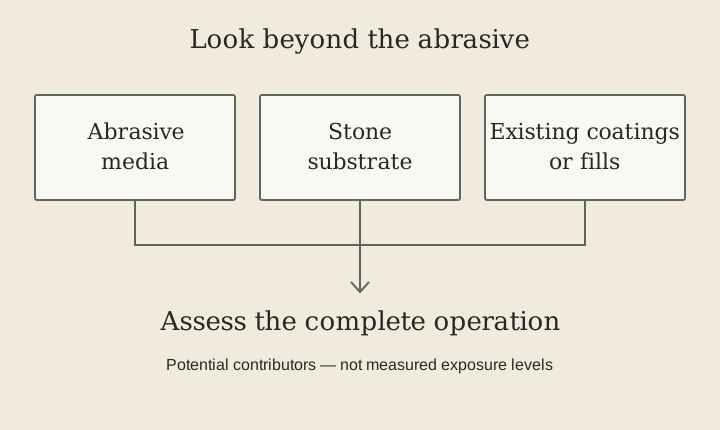
For general-industry silica work, 29 CFR 1910.1053 separately addresses exposure assessment (§d), engineering and work-practice controls (§f), respiratory protection (§g) and housekeeping (§h). Construction has a separate standard; the scope provisions matter. A historic reference to ventilation or a modern equipment label cannot replace determining the applicable requirements and actual exposure.
See also
Section titled “See also”Sources
Section titled “Sources”- LM p.98, 134–135, 166–167 (Cook; advertisements).
- GMB16 p.497 (Foster & Hosler, supplier’s notice).
- MN15 bound covers (classified advertisement).
Source and editorial credit
Section titled “Source and editorial credit”LM publication record · GMB16 publication record · MN15 publication record.
This is a modern AI-assisted editorial summary. Named contributors are credited with their specific statements above; unidentified contributors remain unverified. Publication editors are not assumed to have written individual articles. Page references use the private scan; source access, edition and rights limitations are recorded in the linked register.